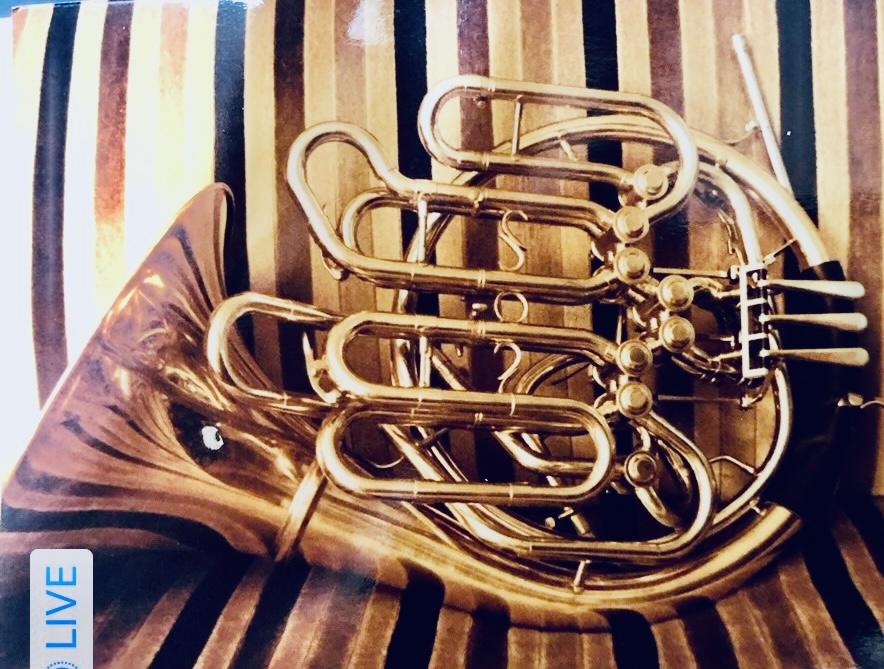
Phil Meyers shared the following recollection of George McCracken’s design ideas and the development of the double valve horn:
George McCracken: ideas realized
- All bends the same radius.
- The port through the valve exactly the same diameter as the tubes — no constriction — because each valve was three-way and had only one port.
- No bend sharper than 180 degrees.
- Every fingering from 0 to 123 goes through eight valves and exactly the same amount of bends.
Goal: even resistance.
Absolutely achieved. When playing this horn you became aware of how much you had to manipulate a normal horn to achieve evenness.
Shortcoming: it was made with King parts, so it sounded like a King.
Bill Slocum and I were talking every day, and all of a sudden Bill said, “I want to talk about George. He’s making an eight-valve horn that has four big design improvements, and I think you should try playing this horn.” Well, I was in New York at this point, but my parents were still in Elkhart. Bill at this point was at Youngstown State University, right on the turnpike — I-80, actually — on the way home, so the next time I went home I played it. I couldn’t believe it.
So we came to a deal that he would make me one. This was around 1980–81, for $2,000, which was a good price even then. Part of the deal was that I would take it to the horn conference that year in Potsdam, New York, and play it, introducing it to the world as principal horn of the New York Philharmonic. I told him I would need it by Christmas so that I could learn to play it without the usual manipulations we all do, like bending in and out of slurs. You didn’t have to do that on this horn, and I needed time to retrain those habits.
By the time the horn arrived, it was too close to the conference for me to feel fully ready to perform on it. Still, the concept behind the instrument stayed with me.
My past, growing up in Elkhart, Bill Slocum, and Chuck Ward, King Eroica
In 1970–71 I studied with Bill Slocum, and that began a close friendship. We spoke on the phone constantly — probably ten hours a week at one point.
During this time I met Chuck Ward and became aware that Bill and George McCracken had a relationship. The newly redesigned McCracken/King Eroica horn had just come out. At some point Bill bought one, and when I heard him play a recital at Kent State University in 1971, it was on the Eroica.
In those days all the major companies except Holton had a Chambers/New York model and a Geyer/Chicago model. Usually that was it. Conn had the 8D and the 6D, but they were not making any money off the 6D, so they put zero effort into their supposed Geyer model. I grew up in Elkhart, my dad was a band director there, and I played in Municipal Band with people who worked in the factories. At that time the music business in Elkhart was packed: Olds, Reynolds, Holton, Besson, Getzen. When I went to buy my first French horn, the local shop had 14 different models for me to try, which I did with a blindfold on. It came down to either the Reynolds Geyer model or the Holton. I got the Reynolds, all of them coming in at around $300–400 in 1962–63.
So when George redesigned the Eroica, he was continuing a tradition that had already been going for some time.
I was up in Halifax talking to Slocum one night and for some reason he said, “You should try one of these Eroicas. They’re really good.” So the next time I got down there, in spring 1972, I tried Bill’s. I will tell you without reservation that while to me the middle range felt cavernous and difficult to get to the core of the sound, of all the double horns I ever played this had the easiest and most secure high register I have ever played. If descants and triples had not come about, when I got to New York I would have gotten an Eroica for the high things.
But I knew that with the way the middle range sounded in my hands, I would have sounded like a New York-style nightmare to whatever audition committee I played for. So there was no Eroica purchase for me.