Doug Hall shared the following conversation with Alan DeMattia:
Alan DeMattia, Cleveland Orchestra Horn Emeritus
8D’s, Eroica’s, Model 7’s
(Doug noted that he missed the beginning of the conversation.)
Alan DeMattia: The three of the bells were so thin that they didn’t have structural integrity. They may have been able to cut them and make bell flares out of them, but only two horns were made, and unfortunately by then the King 46 mandrel had been damaged, so they didn’t put 46 pipes on. The horns didn’t have the airflow that Rick wanted, so they only made two. I was second horn at this time, so we gave them back to the factory, and I know for a fact that Jim Jones, who had been the horn professor for many years at Ohio State, bought one of them after he came to Cleveland to be the chair of the music department at Cleveland State University. Since he wasn’t playing the horns regularly anymore, I wanted something easier to play. He got one of them. I think Ted Albrecht got the other. I want to say that Ted was in Louisville, Kentucky. I don’t know if it’s the same one or if it’s the other one.
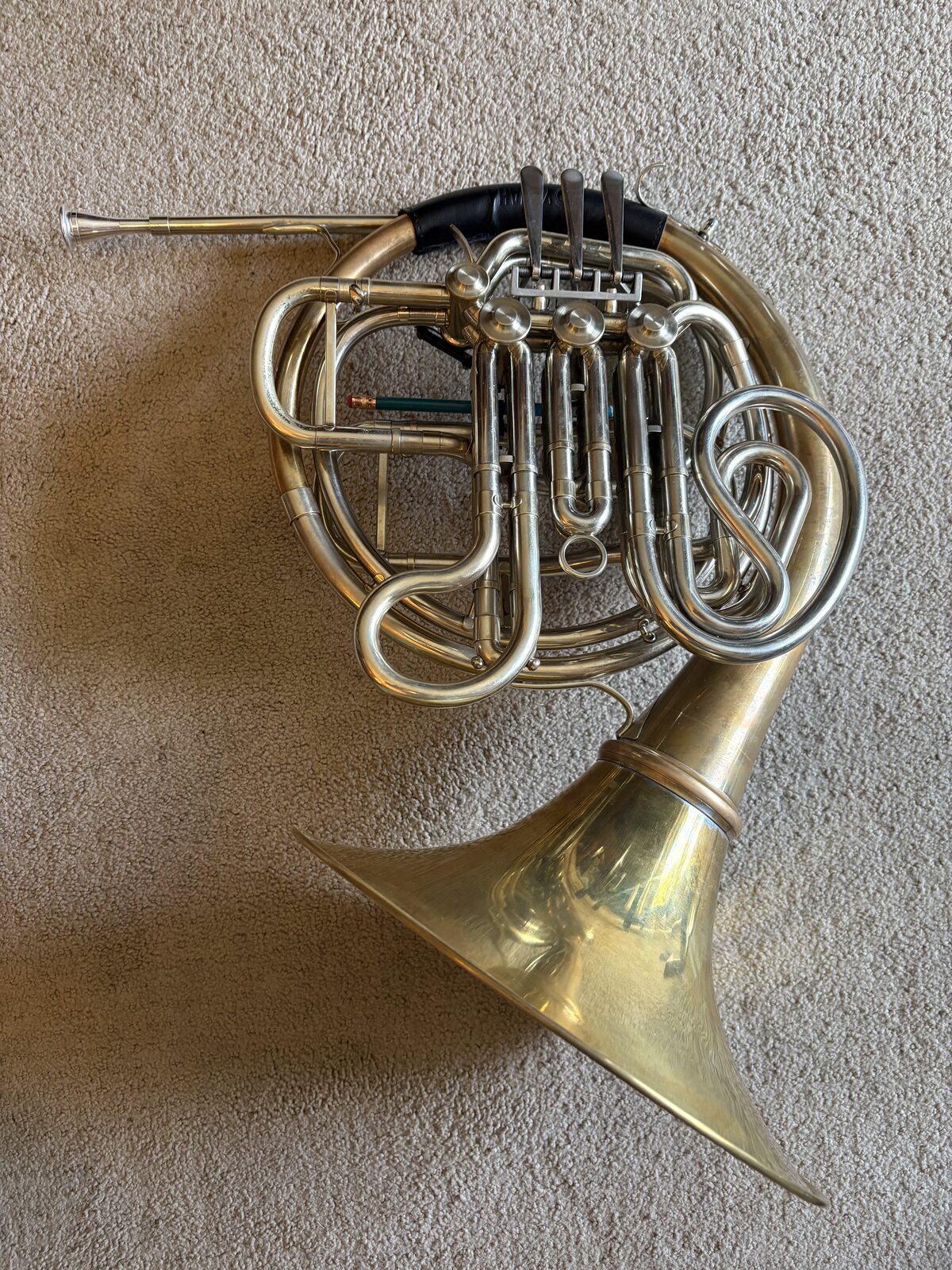
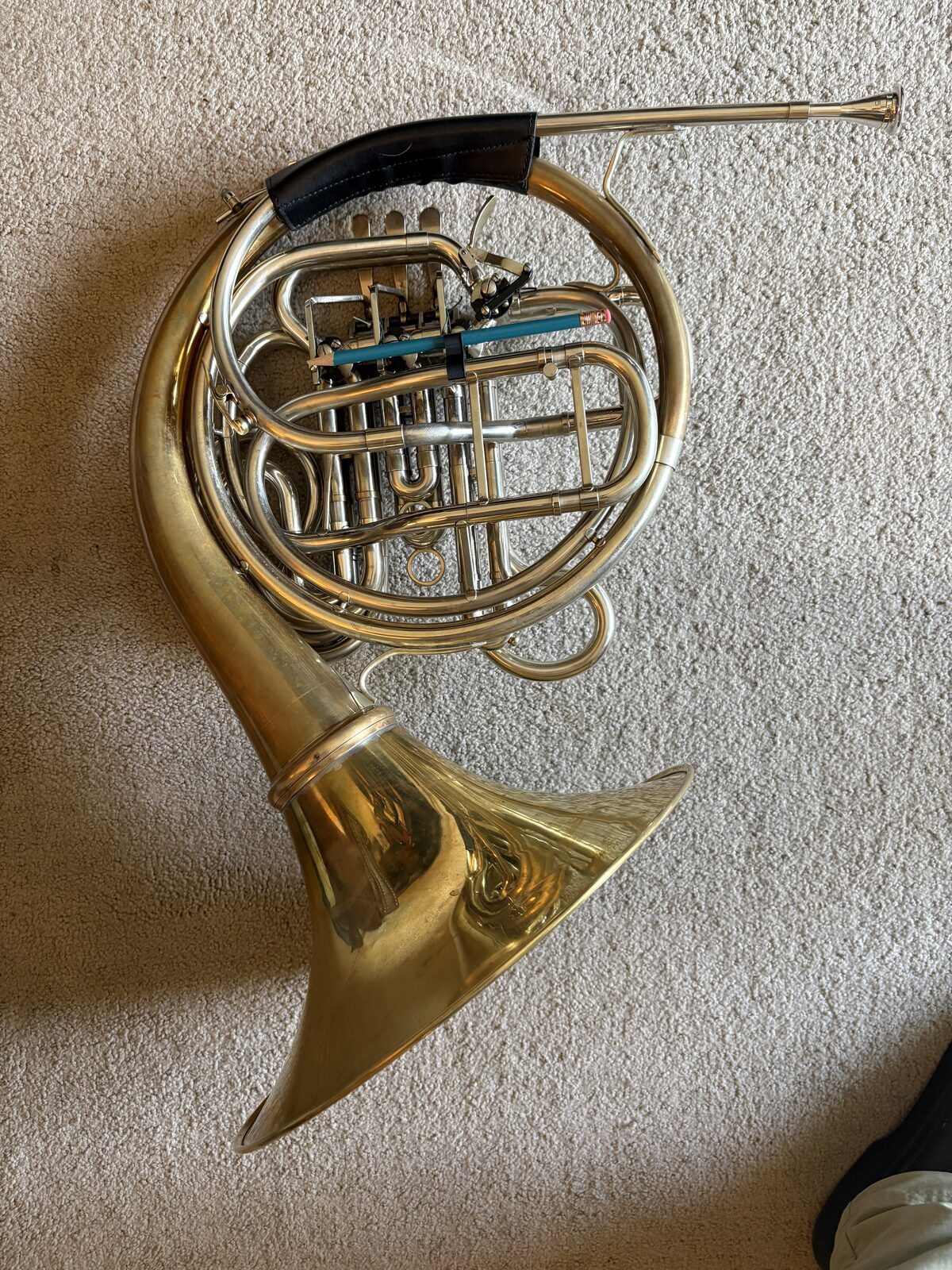
At any rate, after Dr. Jones died, his wife asked me to sell the one that she had. It sat around my house for probably eighteen months. I damaged my 8D, and it needed to be repaired. I was playing fourth horn on Tchaik Four in Lexington, Kentucky, and my other horn is the Schmidt model King. I didn’t trust it to give me the power and the flexibility that I wanted for such low playing, so I borrowed the Eroica and realized that I liked it better than my 8D. I got my 8D repaired, and it’s for sale. Dr. Jones was able to find a King 46 pipe. It was owned by a fellow named Trent Chester that lives in town, and once Trent buys something he rarely sells it or gives it away, but he was willing to give Dr. Jones the King 46 pipe, so that helped the horn a lot. It gave the correct airflow. But the fortes were still unorganized because of that super-thin red brass bell, and unfortunately the factory had changed the supplier of the threaded rings that they use for cut-bell horns. The horn was made in 1986 or 1987. Dr. Jones had the bell cut in about 1990, and I wanted a nickel Eroica bell, which was going to be hard to find in any circumstance — and preferably to find one that had been cut in about 1990. Darned if I didn’t find one.
So I didn’t have to change the ring or do anything. I just screwed it on the horn. Now, for me, I know that there are horns out there that cost $15,000 and $18,000, but for me this Eroica in this configuration is the best horn I’ve ever touched. It gives me the airflow that I want. It’s extremely open in terms of airflow — the most open horn I’ve ever touched. A lot of horns, when they’re that open, do not give you enough help with a pitch center. So if you’re playing long notes, especially in the high range when your lip might get tired, it’s hard to get to the right pitch and it’s hard to hold the right pitch once you get it. So this horn is that wonderful combination of being extraordinarily free-blowing, but it really helps you because it just plays so well in tune with a nice pitch center. So, as I said, for me, it’s the best horn on the planet. Pardon all the Alexander players and Engelbert Schmidt players and everybody else, because I think I paid Mrs. Jones $2,000 or $2,500 for the horn and maybe paid another $600 for the bell, so pardon everybody who has a horn worth more than $3,000 — but my horn is better than yours, and that’s what it cost.
Alan DeMattia: I was a student at Kent State University, and I was playing an N-series 8D that was just picked off the shelf and handed to me: this is your horn. Nobody ever would have chosen it; it was flawed. So I was going to George for some work to try to get that horn playing better. He did a little valve work and he also put on a King 46 pipe. That was a little bit longer than the original pipe, and that combination of events helped the horn quite a bit. About the same time, I was able to buy the first generation of Eroica with the flawed bell, and pretty soon after he redesigned the bell and fixed the intonation problems of the Eroica, he said, “Alan, I know you’ve got that Eroica and I know you’ve got this 8D, and let me just recommend that you buy one of the brand-new Eroicas. I think you’ll like it better than either one of those.” So I sold both of those horns.
Alan DeMattia: I played it through college. My wife and I bought our first house around 1982, so I sold it around 1982 when we were assembling our down payment, and I’ve regretted that moment ever since — although I have to say that this one is better than that one.
Alan DeMattia: So it worked out well in the end, and I wouldn’t have been able to play it in the Cleveland Orchestra, so it worked out fine. But I sold a really good horn that I wish I hadn’t sold. I was forced to play an 8D, and I had good 8D’s — many good 8D’s — but none of them were like this. This Eroica is just a special horn. You might not know this, but sometime around 1975 the big metal companies, from which the musical instrument companies buy their metal stock, took the old alloy that we call nickel silver — which has no silver in it — off the market.
Alan DeMattia: The new formulation makes a duller sound, which I think is one of the reasons I like my current Eroica so much. Even though the nickel-silver parts are the new formulation, it’s still got that beautiful sound. I think what saved this horn is the red brass bell tail. It gives me that extra energy in the sound that you don’t get in an 8D past about 1975, because I know I bought an N8D in 1978 when I got back in with Cleveland. By 1978 I was playing an 8D, although I didn’t sell the Eroica for several more years, but that was the new alloy and they’re just more dull. If you listen to current orchestra sections that still play 8D’s compared to the same section fifty years ago, you’ll hear the difference in timbre — they’re dull. The new players don’t know it because they’re playing in an 8D tradition and they don’t know that they’re dull compared to their mentors, but they are.
Doug Hall: Yeah, and I’ve got a pre-letter 8D, but the bell is so thin.
Alan DeMattia: Well, what you could do is this: if it’s thin and softer, take your burnishing rod and very, very carefully burnish it until your elbows are sore, and you’ll give some structural strength to that thin metal. That will put some life back in the sound also, because if it’s thin and soft like that, it’s probably dull. That’s one of the reasons the young players don’t know how dull the new 8D’s are, because the old 8D’s they’re playing today are all dull because they’re thin and soft. They’re not playing an old 8D from 1957 when it was nice and strong and firm.
Alan DeMattia: So you might be able to save that horn by very, very carefully burnishing it. The last time I had a guy up here named Stan burnish a horn like that, the next time I saw him he had both of his arms in a sling, and it was my fault — but he fixed the horn.
Alan DeMattia: I know the story you’re talking about — Ralph’s piston-valve descant King horn. I don’t think I ever played the full double, but I played the descant one time. We were playing at Ralph Wagner’s place, and Ralph Lockwood brought that horn.
Alan DeMattia: My current medium-bell brass horn is a Schmidt model King that I paid $50 for because it basically had been run over by a car. But the problem with the Schmidt model King, and the Kruspe wrap in general — extending, quite frankly, to this day with some of the Fidelio and Cantegni — is that some of the notes cannot center. So when I had the King rebuilt, I had a King Fidelio bell tail, a Conn 6D leadpipe, because that’s essentially a copy of the old Schmidt leadpipe, and of course it’s a Schmidt model King.
Alan DeMattia: I have a magical bell that makes every horn you put it on better. It’s the bell from a 1961 6D, and the rest of the horn was severely damaged. Usually when the horn is damaged the bell flare gets damaged, right? This one was the opposite. The only thing left of the horn was the bell flare, so the horn was crushed in Chuck’s workshop. I said, “Will you sell me the horn?” He said no, he could use some of the braces and ferrules and things on that horn in my repair business. I said, “Will you sell me the bell?” and he said yes. You can put that flare on any horn and the horn will play better, even if it’s an 8D with a totally different rate of taper. It’s just a magical bell. So I put my magic 6D bell on that Schmidt model King, and it’s my favorite medium-bell brass horn. You don’t even have to crescendo on that horn — just think about maybe a crescendo being a good idea, and the horn plays louder.
Doug Hall: I started apprenticing for George back in the 80s for a year for no pay, and luckily somebody told me that while I was doing that, since he wasn’t paying me, I should make some horns. So I ended up making a hand horn with two crooks — an F and an E-flat crook — and then I made a descant horn. At least I came out with two horns. The descant is a tri-valve instrument that’s very similar to what he made for David O’Hanian. Then I got the San Diego Symphony and played thirty-six years, fourth horn. About twenty years ago we reconnected with George. My wife and I had driven across country, and Helen had died of cancer and he lost his house to some cheaters, so he was living in his shop in West Point, Virginia. I thought the best thing to do would be to make him a website. My daughter and dad and I made him a website. I ordered a horn. I’d seen the David O’Hanian horn and it was a great horn — he converted a Schmidt and moved the piston to the middle of the horn. It’s in my write-up.
Alan DeMattia: Are you familiar with the current Dale Clevenger model Dieter horns? That’s a pretty interesting idea, because I think there are acoustical advantages to having a piston thumb valve. Slurs are so molasses-smooth, and then to set up that valve mechanism with a traditional valve lever is just an incredibly ingenious move. I’ve learned how to accommodate that. Before I was in the Cleveland Orchestra, when I played chamber music, since my big instrument was an 8D I had one of the first horns that Carl Geyer made under his own name. It had a tiny bell — even smaller than a Fidelio bell — and it had a piston thumb valve. I learned how to accommodate holding those horns because I had relatively long fingers, so I put the leadpipe at the base of my fingers, where you usually put the leadpipe across the middle of your palm. My fingers were long enough to reach the tips of the valve levers, and having the hand in that position put the tip of the thumb right on that thumb valve. So I’ve never been uncomfortable holding a Schmidt-model horn or any of its copies, whether it be a Geyer or the Schmidt model King that I own now, or the Yamaha. I understand that I’m unusual. It’s simply not an ergonomic setup for everybody.
Doug Hall: One of my players, Darby Hinshaw, has a Schmidt and his hand just gets bound up after a while. He’s kind of small and it doesn’t work very well. But the horn that I ended up making — I wish that I had used the interchangeable bell, because my thought was to make a large bell and a medium bell, and so that’s what I did. But I made two complete horns, and if I had just made the interchangeable-bell system I would have only had to make another valve section.
Alan DeMattia: Yeah, the interchangeable-bell system only works on the Eroica in terms of 8D versus Eroica. The F-side tuning slide is on the same side of the horn as the main tuning slide, and one of the tubes that goes down would run into either the bell tail or the first branch when you’re folding the body of the horn up. So if you want that, it has to be very carefully designed so that everything can be shifted without parts banging into each other. But it works beautifully on an Eroica, and if I’m ever in the same location so I can show you, even though my Eroica isn’t set up that way, I could show you and you would understand immediately how it works. The bell and the first branch come off as a unit.
Doug Hall: I have Tom English’s horn. He passed away, and Alex Lane contacted me and asked if I knew McCracken horns. Tom would never send me pictures of the horns for the website, even though I’d been bugging him for a while. Then I got this call saying he had passed away and his family didn’t know what to do with the collection. I said yes, please send me a picture — and it turned out he had Ralph’s double piston horn, two double-valve double horns, and a single B-flat horn. The single B-flat horn has your removable bell system, so there’s a nickel bell and a brass bell, and they’re both exceptional. Well, all three are exceptional horns, and of course now I have them all.
Alan DeMattia: George was really the only person working on efficiency of fluid flow. Lawson’s claim to fame was rate of taper and metallurgy, and George was perfectly content to use the metals that were available, which is smart because that’s what’s going to be commercially available. He worked a little bit with taper — I mean, he used that for a curve on the Eroica bell — and he came up with the 55, the 50, and the 46 leadpipes. I’ve saved a lot of horns with the 46 pipe if they had been damaged or had acoustical problems. Interestingly enough, a couple horns that I had already saved from pieces of trash to really, really good, I’ve been able to save even further by taking off the 46 pipe and putting on a 6D pipe.
Alan DeMattia: I have an Alexander that’s one of the first Alexanders ever built. The Alexander model 103 was designed in 1909, and mine dates from approximately 1910. When I got it, it had some kind of generic Allied leadpipe on it, so I never had access to the original. I had a King 46 pipe on it for a while and then, just for giggles, I had Chuck Ward bend me up a copy because there are only so many leadpipes that go from small to large in that amount of span. The old Alexanders had a very short leadpipe.
Alan DeMattia: All right — if you and I are ever in the same town together, we have to get together for coffee, because you’re the kind of guy we could sit and talk about stuff. I probably haven’t answered any questions for your presentation or article, but we can talk more later. Let’s stay in touch.